
Downtown Development
Facing Economic Problems
Coleman Young took over as mayor amidst economic problems that had been developing in Detroit for decades. The automotive industrial base that had made Detroit the Motor City had begun to shift after the Second World War, as a combination of automation, plant relocation, and foreign competition hollowed out economic opportunities in the city and slowly undermined the city’s tax base. Widespread racial discrimination in housing and employment had reinforced racial disparities in wealth and income and created areas of intense poverty in Detroit’s west side and Black Bottom neighborhood. After peaking in 1950, the city’s population began a decades-long decline, fueled by suburbanization and white flight. Just as Coleman Young assumed office, these problems were exacerbated by an Arab oil embargo and the onset of stagflation, which produced a national economic downturn. The confluence of these forces dramatically undermined Detroit's local economy and municipal tax base during the 1970s. Unemployment in the city’s poorest neighborhoods, already hovering at 14 percent in 1970, would reach an appalling 28 percent by the decade's close. During those same years the city lost more than 300,000 tax-paying residents.
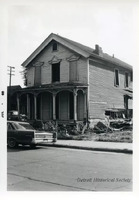
Detroit's economic and social problems had roots in the 1940s and 1950s, but they accelerated with deindustrialization and White flight in the 1960s. This abandoned house was photographed a year after the city erputed in violence during the uprising/disorder of 1967.
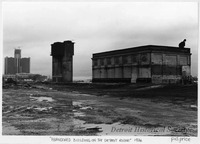
Detroit's economic difficulties worsened in the 1970s. When Coleman Young became Mayor the Detroit riverfront was littered with old and defunct industrial sites, like this abandoned building, pictured in 1976.
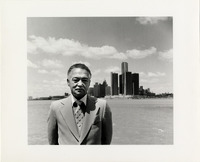
The fledgling Young administration made economic renewal, and the downtown development specifically, a priority. The Renesaince Center—completed in 1977 and pictured here behind Coleman Young—was a symbol of those efforts.
While debates over policing took center stage in Coleman Young’s mayoral campaign against Police Commissioner John Nichols, economic issues were always near to the former union organizer’s heart, and Detroit’s lagging economy ensured that they came to join police reform as a principal priority of Young’s administration. The twin focus was made clear in Young’s inauguration speech in which he pledged “to attack the economic deterioration of our city.” In the same speech Young also drew a connection between issues of crime and policing and economic conditions. The city, he argued, faced “a problem of crime, which is not unrelated to poverty and unemployment.” In light of that connection, Young announced his intention to “attack both of these problems vigorously at the same time.”
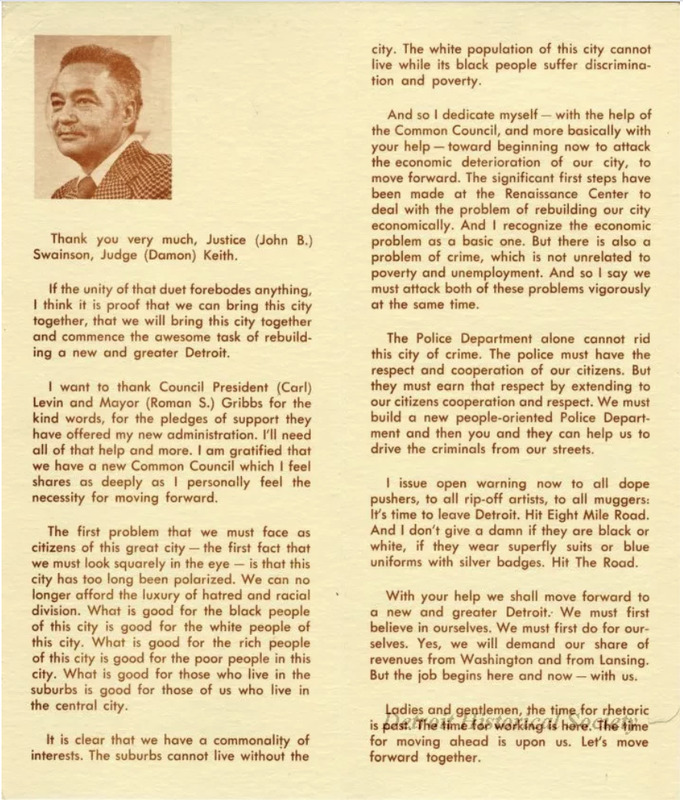
Coleman Young's 1974 Inaugural Address
Although Coleman Young’s inaugural address proposed approaching crime and economic decline as interrelated issues, it left the exact nature of their relationship undefined. The short address did not answer the question of how in practice Young’s mayoral administration would connect policies aimed at economic revitalization with those aimed at crime control. The connection could go both ways. Working to alleviate poverty, inequality, unemployment, and racial discrimination could be seen as a means of addressing the social conditions which had created relatively high crime rates in the first place. But high rates of crime could also be taken as a major cause of Detroit’s economic challenges, contributing to flight of middle class residents and businesses out of the city. Pouring additional resources into policing, could thus be viewed as a necessary first step for addressing the city’s economic woes.
Initially, Coleman Young’s approach seemed to reflect both ideas. The ten policy goals which he set for his first 100 days in office centered around police reform, crime control, and economic development. Young sought to increase enforcement against drug and weapon offences. He would attempt to increase police accountability and police community relations. His goals also included the establishment of an urban economic development authority, the promotion of growth in downtown Detroit, the provision of community resources for small businesses, as well as housing and tax reform. Finally he set out to increase the ease of transportation into Detroit, with an eye towards luring suburban consumers back into the city proper. With his early objectives addressing both ends of the relationship between crime and economic conditions, the balance in Young’s approach would be determined by the actual implantation of those objectives over the course of his administration.
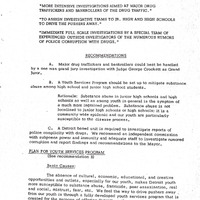
Point 1 - Drug Traffic
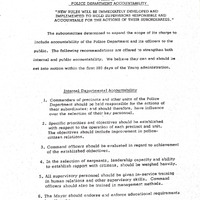
Point 2 - Police Accountability
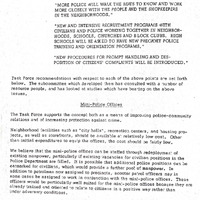
Point 3 - Police-Community Relations
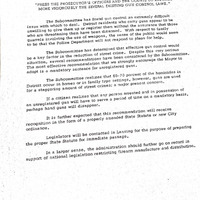
Point 4 - Gun Control
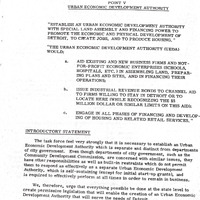
Point 5 - Urban Economic Devlopment
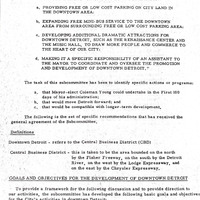
Point 6 - Downtown Detroit
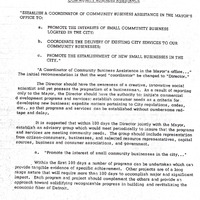
Point 7 - Community Business Assistance
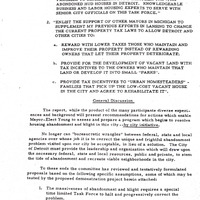
Point 8 - Housing and Tax Reform
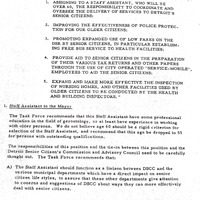
Point 9 - Senior Citizens
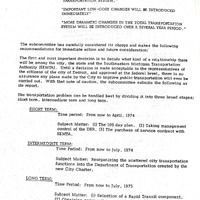
Point 10 - Transportation
A Downtown Renaissance?
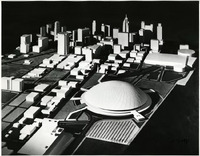
Downtown development was a project that united Coleman Young with business leaders such as Henry Ford II. Although the arena model pictured here was never built, the Joe Lewis Arena fulfilled the ambitions of Detroit Renaissance for a riverfront sports stadium.
As historian Alison Isenberg argues in her book Downtown America, the central business districts that make up the downtowns of most American cities have long been favorite targets for the improvement projects of civic boosters, municipal officials, and urban planners. Centers of urban commerce and urban life, successful business districts typically produced high property values and therefore served as an important source of tax revenue for cities.
A focus on downtown revitalization in Detroit predated the Coleman Young administration. In 1970 prominent members of Detroit’s business community created a nonprofit organization called Detroit Renaissance which aimed to raise funds to bring new development projects, businesses, and positive publicity to the city’s central business district and downtown riverfront. Their initial efforts centered around advertising campaigns and promoting the construction of a new sports stadium on the riverfront, to be accompanied by a large hotel and convention center.
In 1972 Detroit Renaissance member Henry Ford II led the Ford Motor Company and a consortium of other businesses in funding a massive riverfront complex called the Renaissance Center which would house a hotel, an indoor shopping center, and four large office towers. As its name suggests, the Renaissance Center’s backers conceptualized the development at least partly as a means to spur additional investment in Detroit’s central business district, and by extension counteract the economic downturn of the city as a whole. Promotional materials, such as the video below, painted the Renaissance Center as a sign of Detroit’s economic resilience and potential for future growth.
As Mayor, Coleman Young similarly emphasized the importance of downtown Detroit in his plan for the city’s broader economic renewal. In his 1994 autobiography, Young recalled that he believed “that the strip from bridge (Ambassador) to bridge (Belle Isle) had to be the starting point in the rebuilding of Detroit,” and the riverfront Renaissance Center was “the cornerstone from which the reconstruction of Detroit would emanate.” When several of the Renaissance Center’s financial backers, themselves facing economic difficulties, threatened to pull out of the project, Young worked with Henry Ford II to convince them to stay on board.
Stimulating downtown revitalization was also one of the goals Young outlined for the first 100 days of his administration. Given the reality of white flight to the suburbs, Young’s approach to fostering downtown growth centered around competition with suburban shopping centers which were increasingly pulling consumers away from Detroit. His administration sought to expand transit and parking options in the central business district and develop additional leisure and entertainment attractions in the downtown area. Under Young’s administration in the mid-1970s the city built a riverfront park called Hart Plaza and contributed to the construction of the Joe Lewis Arena, fulfilling the ambition of Detroit Renaissance for a riverfront stadium. The Young administration viewed these entertainment attractions as means to lure suburbanites back to the central city, where they might spend money and contribute to a commercial revival downtown.
Making Detroit "Safe" For Business
Centering commercial redevelopment and suburban consumers in plans for downtown revitalization led the Young administration towards seeing crime control as instrumental to, perhaps even a prerequisite for, its economic goals. Especially in the years after the uprising and civil disorder that roiled the city in 1967, Detroit had taken on a negative reputation as a hotbed of criminal activity and violence. In the eyes of the Young administration, increasing perceptions of public safety through greater police visibility in the central business district would be imperative if the city was to lure shoppers and businesses back into the city.
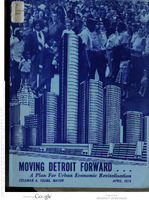
Coleman Young's 1975 Plan for Economic Revitalization
This view was articulated directly in the administration’s official plan for urban revitalization, published by the mayor’s office in April 1975. In a section dedicated to outlining a “public safety program for revitalization,” the plan’s authors complained bitterly about Detroit’s negative reputation in regards to crime: “Some even say the biggest growth industry in Detroit is crime. The media, in its reports, however, fails to dramatize the fact that crime is not peculiar to Detroit, but that crime is a national phenomena and no major city has been able to alter its momentum effectively.” Still, the plan acknowledged that even perceptions of crime could create tangible barriers to economic recovery, explaining that “crime has not only affected the physical and psychological welfare of the Detroit resident, but it has dramatically affected business attitudes and has proved an obstacle to future growth and development."
Coleman Young may have independently believed that crime, or at least perceptions of crime, must be brought under control in order to revive the economic prospects of Detroit and the city’s central business district. But the position of the Young administration’s crime control policy as a pillar of its economic agenda was also shaped by the influence of Detroit’s business community itself. An internal memo from the early days of the Young administration shows that the Director of the city’s Community Development Commission urged the administration to form a Downtown Coordinating Council to provide an institutionalized channel for downtown business interests, including the Central Business District Association, Detroit Renaissance, the Chamber of Commerce, and the Detroit Convention Bureau to weigh in on economic development policy and coordinate their activities. Many of these business leaders were interested in working with the Young administration in order to establish greater police presence near their businesses. Members of the business community responded positively to Young's plan to create police mini-stations, for example, with the police department recieving mulitple requests on behalf of businesses for the establishment of additional mini-stations in specific areas.
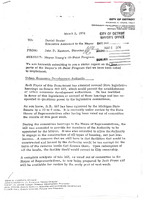
This inter-office memo shows efforts in the Young administration to provide institutional channels for local business leaders to shape economic policy.
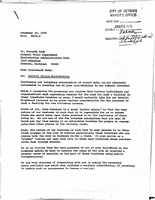
A 1975 letter from B. L. Peyton, a regional Greyhound executive, to a Detroit police Luitenant requesting a mini-station for the Detroit Greyhound bus terminal.
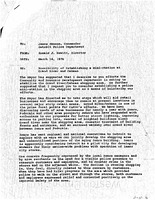
A 1976 letter from Ronald Hewitt, director of Mayor Young's Community and Economic Development Department to police Commander James Bannon. Hewitt advocates for a police mini-station on the city's Northwest side, citing the requests of Sears and Federals department stores.
The connection between policing under Coleman Young and the demands of the business community was also reflected in the specific content of his administration's policies. Young’s 1975 urban revitalization plan included in its section on public safety several programs to provide public subsidies to enhance private security for downtown businesses. The plan proposed spending more than $400,000 to enhance security systems for high rises and major construction projects in Detroit. Another program promised more than $3.7 million a year to employ a private security force, trained by the Detroit Police Department and operating out of precinct headquarters and mini-stations, to “patrol major sites of major new construction and identified renovated housing areas.” Police mini-stations themselves were also listed as a program within the economic revitalization plan, showing how tied crime control, police reform, and economic goals had become under Young’s leadership.
If businesses seems to have exerted sway on Young’s crime control policy in his 1975 revitalization plan, their influence was even stronger the next year, especially in the wake of a prominent disruption by youth at a downtown concert at Cobo Hall in 1976. The young administration responded harshly to the Cobo Hall incident, instituting an emergency youth curfew which gave police new discretionary authority to stop, identify, search, and arrest youth. That intense punitive response must be seen in light of the Young administration’s broader objectives of fostering downtown development by attracting white suburbanites through shopping and entertainment.
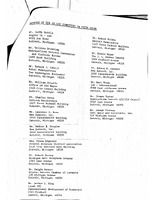
A majority of the members of Coleman Young's Ad-Hoc Committee on Youth Crime represented business interests.
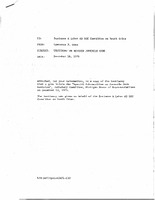
Lawrence Doss' testimony before the Special Subcommittee on Juvenile Code Revision reflects how business interests were influencing criminal justice policy under Coleman Young's administration.
More than a response to the desires of downtown business leaders, the crackdown on youth that followed the Cobo Hall incident was directly driven by business leaders themselves, several of whom had been empowered by the Mayor to shape the city’s response to perceived “youth crime” problem. A majority of the members of the Mayor’s Ad-Hoc Committee on Youth Crime, convened in 1976, represented Detroit’s business interests in some capacity, including representatives from Detroit Renaissance, the Detroit Convention and Visitor’s Bureau, the Central Business District Association, and the Chamber of Commerce, as well as several representatives from specific businesses. By the end of the year the committee settled on a set of recommendations that mixed a few criminal justice reforms—including, significantly, moving youth status offenses out of criminal Probate Court and into the hands of the Wayne County Department of Social Services—with a policy empowering judges to sentence juvenile offenders to up to a year of incarceration, something that previously had only been possible through the consent of Social Services.
On balance, however, the committee expected these changes to lead to increased youth incarceration. Testifying on behalf of the group about their recommendations before a subcommittee of the Michigan House of Representatives, the committee’s chairman Lawrence Doss reported that their recommended policies “would require an additional 500-600 new beds in secure detention facilities.”
Sources:
Coleman A. Young Papers, Burton Historical Collection, Detroit Public Library, Detroit, MI.
Coleman A. Young Collection, Walter Reuther Library, Wayne State University, Detroit, MI.
Detroit Historical Society, Detroit, MI.
Thomas J. Sugrue, The Origins of the Urban Crisis: Race and Inequality in Postwar Detroit (Princeton University Press, 1996)
Alison Isenberg, Downtown America: A History of the Place and the People Who Made It (University of Chicago Press, 2004)
Coleman Young and Lonnie Wheeler, Hard Stuff: The Autobiography of Coleman Young (Viking, 1994)
City of Detroit, Office of the Mayor, Moving Detroit Forward: A Plan for Urban Economic Revitalization (Detroit, 1975), HathiTrust, https://babel.hathitrust.org/cgi/pt?id=mdp.39015071335775
Coleman A. Young, "Inaugural Address," January 2, 1974, Detroit Historical Society, https://www.detroithistorical.org/learn/online-research/collection/archive/pamphlet-mayor-coleman-young-inaugural-address-january-2
"Riverfront mall, hotel, suggested," Detroit Free Press, September 16, 1970
"New Life Set for Downtown," Detroit Free Press, November 22, 1970
Michael Maidenberg, "Riverfront Project—Now It's Renaissance Center," Detroit Free Press, March 23, 1973